
Chicken nuggets are a common processed chicken product, widely used in fast-food restaurants, dining chains, food retail, and the frozen food industry. During the industrial mass production of chicken nuggets, the frying process not only influences the product’s color, crispiness, and texture but also determines the degree to which the chicken is cooked internally. Consequently, carefully setting the frying duration and adjusting the oil temperature—based on specific product requirements—are critical aspects of the production process. So, how long should chicken nuggets be fried?
The frying time for chicken nuggets is not a fixed value. The actual duration depends on factors such as the size and thickness of the nuggets, the state of the raw ingredients, the type and amount of coating (breading/batter), the oil temperature, and the heat-transfer capacity of the equipment. In an industrial production setting, appropriate parameters should be determined through trial runs before being applied to continuous, large-scale processing.
1. Reference for Chicken Nugget Frying Times
Under typical industrial frying conditions, the following ranges may serve as a preliminary guide, depending on the product type and processing objectives:
Small, fresh chicken pieces: approximately 3–5 minutes
Thicker, coated (breaded/battered) chicken nuggets: approximately 4–7 minutes
Frozen raw chicken nuggets: parameters for fresh chicken cannot be applied directly; specific requirements must be determined based on product specifications and equipment validation.
2. How does frying temperature affect frying time?
Frying temperature and frying time are closely linked. At lower oil temperatures, chicken pieces heat up more slowly, requiring a longer frying time; this can also lead to increased oil absorption by the product. Conversely, if the oil temperature is too high, the outer layer of the chicken may brown or even char rapidly, while the interior remains undercooked.
For certain types of coated chicken products, a temperature range of approximately 170–180°C can serve as a starting point for initial testing, with the optimal oil temperature and dwell time subsequently determined through practical trials. However, for frozen raw chicken, thick-cut pieces, or products with different formulations, separate validation is required; the same parameters cannot be applied universally.
3. How can you determine if chicken nuggets are properly fried?
Assessing whether chicken nuggets meet the required standards involves evaluating their appearance, texture, and internal temperature.
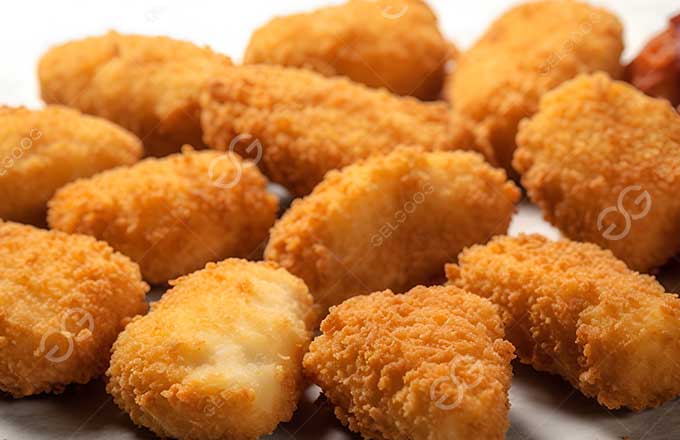
First, the finished product should have a uniform, golden-yellow appearance, with the breading or batter coating adhering well to the surface—showing no signs of significant charring or large areas where the coating has flaked off. Second, the outer layer should possess a level of crispiness consistent with the product’s intended profile, while the interior should remain appropriately tender.
Most importantly, it must be verified that the internal temperature at the center of the chicken has reached validated food safety standards. For chicken products, a common safety benchmark is an internal temperature of 74°C (165°F). Manufacturing facilities should use calibrated temperature-measuring instruments to check representative samples, and establish control requirements based on applicable regulations and validated processing procedures.
4. What should be considered when deep-frying chicken pieces?
- Maintain stable oil temperature.
- Properly control the feed quantity and frying duration.
- Keep the frying oil clean.
- Pay attention to the specifications of the chicken pieces and the condition of the raw materials.
- Select frying equipment suited to the factory’s production capacity.
The frying time for chicken pieces generally needs to be adjusted based on product size, the state of the raw materials, oil temperature, and specific processing objectives. For certain breaded or battered chicken products, one might begin by testing a range of approximately 3–7 minutes; however, the final parameters must be verified through actual production runs, ensuring that the center of the chicken reaches a safe, fully cooked state.